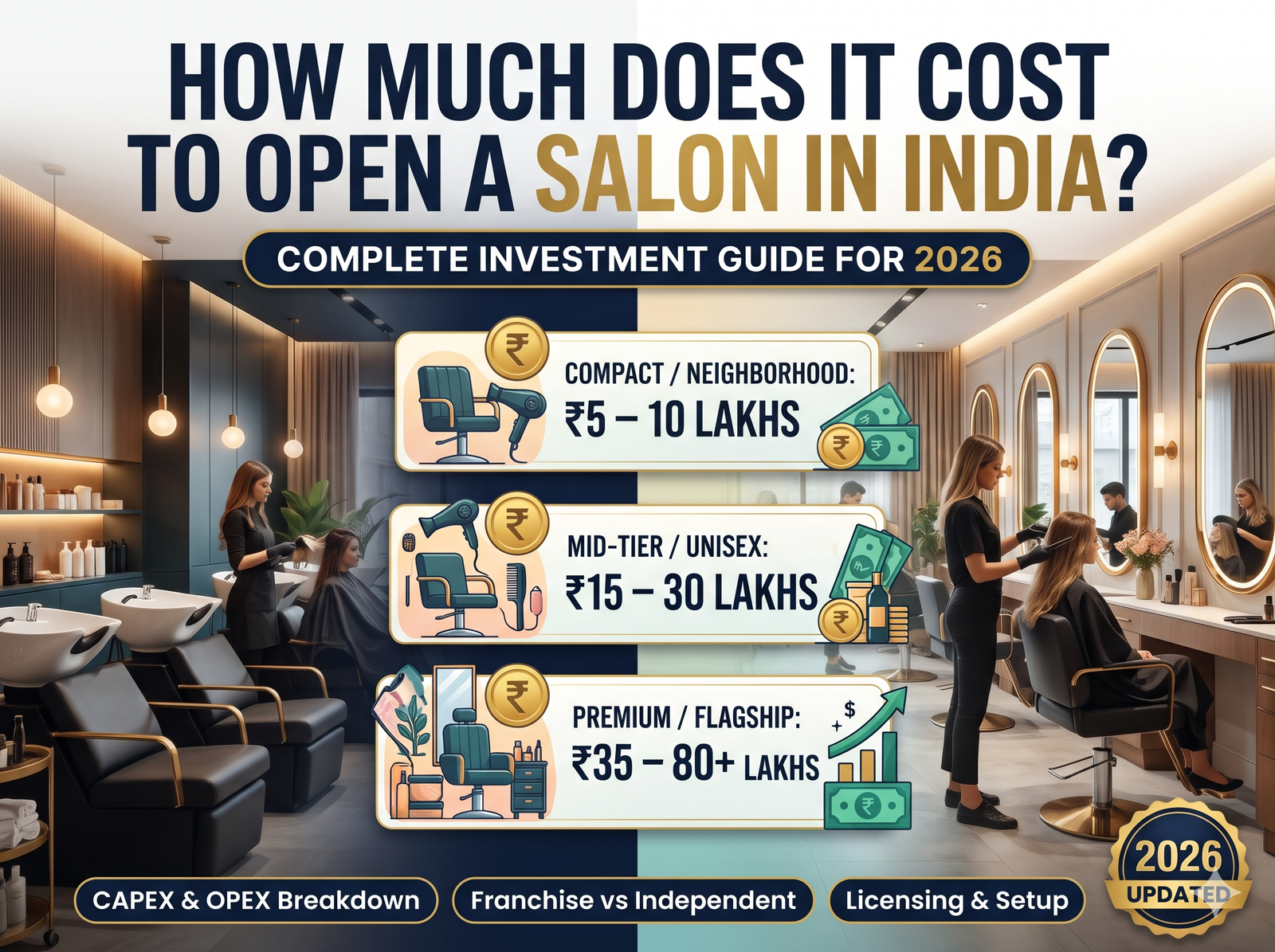
How Much Does It Cost to Open a Salon in India? Complete Investment Guide for 2026
Opening a salon in India in 2026 can be a profitable business opportunity for entrepreneurs who understand the beauty industry, customer expectations, and the investment required to establish a professional salon. With increasing demand for haircare, skincare, grooming, bridal makeup, nail extensions, and advanced beauty treatments, the Indian salon industry offers significant opportunities for both independent salon owners and franchise investors. However, one of the first questions every aspiring salon entrepreneur asks is: How much does it cost to open a salon in India? The investment depends on several factors, including the salon’s location, size, interior design, equipment, number of employees, product inventory, marketing strategy, and business model.In 2026, opening a small neighbourhood salon may require an investment of approximately ₹5 lakh to ₹10 lakh, while a professionally designed mid-range salon may require ₹12 lakh to ₹25 lakh. A premium salon or established franchise model can require ₹25 lakh to ₹50 lakh or more. In this complete investment guide, we will explain salon setup costs, equipment requirements, staff salaries, operating expenses, franchise opportunities, profitability, and the steps required to start a successful salon business in India.
1. Total Investment Required to Open a Salon in India in 2026
The total cost of opening a salon depends primarily on the business model and the services you plan to offer.
Here is an estimated investment breakdown for different salon categories:
| Salon Type | Estimated Investment |
|---|---|
| Small Unisex Salon | ₹5–10 Lakh |
| Budget Salon | ₹8–12 Lakh |
| Mid-Range Professional Salon | ₹12–25 Lakh |
| Premium Salon | ₹25–40 Lakh |
| Luxury Salon | ₹40–75 Lakh+ |
| Salon Franchise | ₹20–50 Lakh+ |
These figures are indicative planning estimates rather than fixed market prices. Actual costs depend on the city, property condition, rental deposit, salon size, equipment quality, and brand requirements.
For someone entering the beauty industry for the first time, a professionally planned mid-range salon can offer a practical balance between investment, service quality, and business potential.
2. Salon Space and Rental Cost
Location is one of the most important decisions when opening a salon. A salon should be accessible, visible, and convenient for its target customers.
We generally recommend considering locations such as:
- Main commercial markets
- Residential societies
- High-street shopping areas
- Shopping complexes
- Premium residential neighbourhoods
- Areas near offices, colleges, and lifestyle stores
How Much Space Is Required?
The required space depends on the number of service stations and facilities.
| Salon Category | Recommended Area |
|---|---|
| Small Salon | 300–500 sq. ft. |
| Medium Salon | 600–900 sq. ft. |
| Professional Unisex Salon | 1,000–1,400 sq. ft. |
| Premium Salon | 1,500–2,500 sq. ft. |
Estimated Monthly Rent
| Location Type | Monthly Rent |
|---|---|
| Small City Market | ₹10,000–₹25,000 |
| Developing Commercial Area | ₹20,000–₹40,000 |
| Established Market | ₹35,000–₹70,000 |
| Premium Commercial Location | ₹60,000–₹1,50,000+ |
In addition to monthly rent, property owners may require a security deposit of two to six months, depending on the rental agreement and location.
Our recommendation: Choose a location based on customer purchasing power, accessibility, parking facilities, and competition rather than selecting the most expensive commercial property.
3. Salon Interior Designing and Setup Cost
Salon interiors play an important role in customer experience and brand positioning. A professional salon should look hygienic, organised, comfortable, and visually appealing.
The interior should reflect the services and price category of the business.
Essential Interior Requirements
- Reception and billing counter
- Waiting area
- Hair cutting stations
- Styling mirrors
- Shampoo and hair-wash stations
- Facial and beauty treatment rooms
- Manicure and pedicure section
- Professional lighting
- Storage cabinets
- Product display shelves
- Air conditioning
- Electrical and plumbing arrangements
Estimated Interior Investment
| Interior Category | Estimated Cost |
|---|---|
| Basic Interior | ₹2–4 Lakh |
| Standard Interior | ₹4–7 Lakh |
| Premium Interior | ₹7–12 Lakh |
| Luxury Interior | ₹12–20 Lakh+ |
The final amount depends on civil work, furniture, lighting, flooring, plumbing, electrical installations, and the quality of materials.
We recommend investing in functional interiors rather than spending the entire budget on decoration. Proper ventilation, comfortable seating, lighting, and hygiene facilities directly influence the customer experience.
4. Salon Equipment and Furniture Cost
Professional salon equipment is essential for delivering quality services. Investing in reliable equipment helps maintain service standards and reduces frequent replacement costs.
Essential Salon Equipment
| Equipment | Estimated Cost |
|---|---|
| Styling Chairs | ₹25,000–₹60,000 |
| Hair Cutting Stations | ₹30,000–₹70,000 |
| Shampoo Units | ₹30,000–₹80,000 |
| Professional Hair Dryers | ₹10,000–₹25,000 |
| Hair Straighteners and Curlers | ₹15,000–₹35,000 |
| Facial Beds | ₹15,000–₹40,000 |
| Manicure and Pedicure Equipment | ₹20,000–₹50,000 |
| Waxing Equipment | ₹5,000–₹15,000 |
| Sterilisation Equipment | ₹5,000–₹15,000 |
| Reception and Waiting Furniture | ₹20,000–₹50,000 |
Estimated total equipment investment: ₹2 lakh to ₹5 lakh or more.
These are indicative prices. The actual amount will depend on the number of stations, equipment specifications, and whether you purchase new or used equipment.
5. Salon Products and Initial Inventory Cost
Salon products are essential for maintaining service quality and generating revenue. A professional salon needs products for haircare, skincare, colouring, chemical treatments, makeup, and grooming.
Essential Product Categories
Haircare Products
- Professional shampoos
- Conditioners
- Hair masks
- Hair serums
- Hair spa products
- Keratin and smoothening products
- Hair colour and developers
Skincare Products
- Cleansers
- Facial kits
- Face masks
- Serums
- Toners
- Moisturisers
- Sunscreens
Beauty and Grooming Products
- Waxing products
- Bleach products
- Manicure and pedicure kits
- Nail extension products
- Makeup products
- Disposable hygiene materials
Initial Inventory Budget
| Salon Category | Initial Stock Investment |
|---|---|
| Small Salon | ₹40,000–₹75,000 |
| Medium Salon | ₹75,000–₹1.5 Lakh |
| Premium Salon | ₹1.5–3 Lakh |
We recommend maintaining sufficient inventory for popular services while avoiding unnecessary stock purchases. Products should be selected according to customer demand and the services offered by the salon.
6. Salon Staff and Salary Expenses
A professional salon depends on skilled employees. Even an attractive salon cannot maintain customer satisfaction without experienced hairstylists, beauticians, makeup artists, and support staff.
Recommended Salon Team
| Position | Monthly Salary Estimate |
|---|---|
| Salon Manager | ₹18,000–₹35,000 |
| Senior Hairstylist | ₹18,000–₹30,000 |
| Junior Hairstylist | ₹10,000–₹18,000 |
| Beautician | ₹12,000–₹22,000 |
| Makeup Artist | ₹15,000–₹30,000 |
| Receptionist | ₹10,000–₹16,000 |
| Housekeeping Staff | ₹8,000–₹12,000 |
Actual salaries vary according to experience, city, qualifications, customer-handling ability, and performance incentives.
For a medium-sized unisex salon, we may begin with a team of approximately five to eight employees, depending on the service menu and operating hours.
Estimated Monthly Salary Budget
A medium-sized salon may require approximately ₹1.2 lakh to ₹2.5 lakh per month for salaries and employee-related expenses.
We recommend establishing clear job responsibilities, service targets, attendance policies, customer feedback systems, and performance-based incentives.
7. Salon Licences and Legal Registrations in India
Before opening a salon, business owners should understand the applicable registrations and local compliance requirements.
Depending on the business structure, location, services, and number of employees, the following may be relevant:
- Business Registration: Proprietorship, partnership, LLP, or private limited company, depending on the ownership structure.
- Shop and Establishment Registration: As applicable under the relevant state legislation.
- GST Registration: Registration requirements depend on applicable turnover thresholds, compulsory registration provisions, and the nature of transactions.
- Trade Licence: Where required by the local municipal authority.
- Fire Safety Compliance: Applicable according to the building, local rules, and premises.
- Professional Tax: Applicable in states where professional tax is imposed.
- Employee Compliance: Relevant labour laws, wage requirements, and employee-related registrations.
- Music Licence: Where commercially copyrighted music is played and the applicable licensing requirements are triggered.
The exact requirements vary by state and municipality. We recommend consulting a qualified accountant or local business consultant before commencing operations.
8. Marketing and Branding Investment for a New Salon
Opening a salon is only the beginning. Attracting customers and building brand awareness are equally important.
A new salon should have a marketing strategy before its opening date.
Essential Marketing Activities
- Professional salon logo and branding
- Google Business Profile setup
- Instagram and Facebook pages
- Professional salon photographs
- Opening-day promotional campaigns
- Local influencer collaborations
- WhatsApp customer communication
- Customer referral programmes
- Membership cards
- Local advertising campaigns
- Promotional service packages
Estimated Marketing Budget
| Marketing Activity | Estimated Budget |
|---|---|
| Branding and Logo | ₹5,000–₹15,000 |
| Photography and Video | ₹10,000–₹25,000 |
| Social Media Marketing | ₹5,000–₹15,000 |
| Paid Advertising | ₹5,000–₹20,000 |
| Opening Promotion | ₹10,000–₹25,000 |
Recommended initial marketing budget: ₹30,000–₹75,000.
We recommend focusing on local customer acquisition, Google reviews, referral marketing, and social media content that demonstrates actual salon services and results.
9. Complete Salon Investment Breakdown for 2026
Let us consider an example of a professional unisex salon with approximately 1,000 square feet of space.
| Investment Category | Estimated Cost |
|---|---|
| Security Deposit and Advance Rent | ₹1,50,000 |
| Interior and Civil Work | ₹5,00,000 |
| Salon Equipment | ₹3,00,000 |
| Furniture and Fixtures | ₹1,50,000 |
| Initial Product Inventory | ₹1,00,000 |
| Licences and Registrations | ₹25,000 |
| Branding and Marketing | ₹50,000 |
| Software and Billing Setup | ₹25,000 |
| Miscellaneous Setup Expenses | ₹50,000 |
| Total Initial Setup Cost | ₹13,50,000 |
In addition to the initial setup investment, we recommend maintaining a separate working capital reserve of approximately ₹3 lakh to ₹5 lakh.
This reserve can help cover rent, salaries, electricity, product replenishment, marketing, and other expenses during the initial business period.
Therefore, the estimated funding requirement for this example would be approximately ₹16.5 lakh to ₹18.5 lakh.
10. Monthly Operating Expenses of a Salon
After opening, a salon must manage its recurring operating expenses carefully.
Consider the following example:
| Monthly Expense | Estimated Amount |
|---|---|
| Rent | ₹40,000 |
| Staff Salaries | ₹1,50,000 |
| Electricity | ₹15,000 |
| Product Consumption | ₹40,000 |
| Marketing | ₹10,000 |
| Maintenance and Miscellaneous | ₹15,000 |
| Software and Administration | ₹5,000 |
| Total Monthly Expenses | ₹2,75,000 |
This example excludes financing costs, depreciation, taxes, owner remuneration, and other expenses that may apply.
Product consumption should be monitored as a percentage of service revenue to prevent wastage and protect profitability.
11. How Much Revenue Can a Salon Generate in India?
Salon revenue depends on the number of customers, average customer spending, service pricing, staff productivity, and repeat visits.
Let us consider an example:
- Average customers per day: 20
- Average customer bill: ₹500
- Operating days per month: 26
Monthly revenue:
20 × ₹500 × 26 = ₹2,60,000
Now consider a salon with 30 customers per day and an average bill of ₹700.
30 × ₹700 × 26 = ₹5,46,000
A salon can increase its average bill value by offering complementary services such as hair spa, hair colouring, facials, nail extensions, and premium grooming packages.
These calculations are illustrative revenue scenarios, not guaranteed sales projections.
12. How to Increase Salon Profitability?
A salon should focus on increasing customer retention, improving staff productivity, controlling operating expenses, and developing additional revenue streams.
1. Introduce Membership Packages
Membership cards encourage repeat visits and help create predictable customer relationships.
For example, salons can offer monthly grooming packages, haircut memberships, and prepaid service bundles with clearly defined terms.
2. Promote High-Value Services
Services such as keratin treatments, hair smoothening, advanced facials, bridal makeup, hair colouring, and nail extensions can increase the average customer bill.
3. Focus on Customer Retention
Repeat customers are essential for long-term salon growth.
We recommend:
- Maintaining customer service records
- Sending appointment reminders
- Collecting customer feedback
- Offering loyalty rewards
- Maintaining consistent service quality
4. Build a Strong Digital Presence
Instagram Reels, before-and-after transformations, educational videos, customer testimonials, and professional service demonstrations can help attract new customers.
5. Monitor Daily Sales and Expenses
Salon owners should track:
- Daily revenue
- Number of customers
- Average bill value
- Staff productivity
- Product consumption
- Service-wise profitability
- Repeat customer percentage
A professional reporting system helps identify problems before they affect the business.
13. Is Opening a Salon Franchise Better Than Starting Independently?
Entrepreneurs entering the beauty industry often face an important decision: should they open an independent salon or invest in an established salon franchise?
Both options have advantages.
| Factor | Independent Salon | Salon Franchise |
|---|---|---|
| Brand Recognition | Built from Scratch | Existing Brand Identity |
| Business Model | Developed Independently | Established Operating Framework |
| Marketing | Owner Managed | May Include Brand Support |
| Training | Arranged Independently | May Include Professional Training |
| Investment | Flexible | Depends on Franchise Terms |
| Brand Standards | Owner Controlled | Brand Guidelines Apply |
| Operational Support | Self Managed | Depends on Agreement |
Advantages of a Salon Franchise
An established franchise can provide:
- Brand identity
- Interior and layout guidance
- Staff training
- Service menu planning
- Marketing support
- Product sourcing guidance
- Operational systems
- Business launch assistance
However, franchise investors should carefully review the brand’s reputation, franchise agreement, royalty structure, training commitments, territorial protection, and actual support provided.
14. Understanding Salon Franchise Investment in India
The investment for a salon franchise depends on brand positioning, location, premises, equipment, and the services included in the franchise package.
For a professional salon franchise, the overall project investment may range from ₹20 lakh to ₹50 lakh or more.
For example, a salon franchise model with a ₹20 lakh base setup investment and a separate brand fee of ₹5 lakh plus applicable GST would require additional consideration for equipment, products, working capital, and other exclusions.
Before signing an agreement, investors should understand:
- Total investment required
- Brand fee and applicable taxes
- Royalty structure
- Product purchasing requirements
- Interior and equipment responsibilities
- Training and recruitment support
- Launch marketing support
- Agreement duration
- Renewal and termination conditions
- Cooling-period provisions
- Territory and exclusivity conditions
Important: Always calculate the complete project cost rather than evaluating a franchise only by its advertised brand fee.
15. Why NS4 Salon Is an Option to Explore for Salon Franchise Investors
For entrepreneurs looking to enter the professional salon industry, NS4 Salon offers a franchise opportunity built around salon operations, professional services, brand development, and business expansion.
Established in 2008, NS4 Salon has developed its presence in the Indian beauty and grooming industry.
Its franchise business model is designed for entrepreneurs who want to establish a professional salon with an organised business structure.
Key NS4 Salon Franchise Highlights
- Professional unisex salon concept
- Established salon brand identity
- Franchise business model
- Interior and setup guidance
- Professional service offerings
- Staff training and operational guidance
- Marketing and brand promotion support
Indicative NS4 Salon Franchise Investment Structure
Based on the franchise model discussed:
| Particulars | Investment |
|---|---|
| Base Investment | ₹20,00,000 |
| Brand Fee | ₹5,00,000 + GST |
| Cooling Period | 180 Days |
| Estimated Setup Time | 60–75 Days |
| Recommended Space | 1,000–1,400 Sq. Ft. |
| Team Requirement | Approximately 8 Professionals |
Product and equipment costs are not included in the stated ₹20 lakh base investment and should be budgeted separately.
The final investment, inclusions, royalty conditions, and other commercial terms must be confirmed through the latest franchise agreement.
Who Should Consider an NS4 Salon Franchise?
- Entrepreneurs interested in the beauty industry
- Existing salon owners planning expansion
- Investors looking for a structured salon business
- Business owners interested in the grooming and beauty sector
- Individuals interested in building a professional salon team
Entrepreneurs should evaluate their location, financial capacity, market demand, and operational involvement before investing.
16. Common Mistakes to Avoid When Opening a Salon
Many new salon businesses struggle because of poor planning rather than a lack of market demand.
We recommend avoiding these common mistakes:
1. Choosing the Wrong Location: A low-rent property may not generate enough customer traffic.
2. Overspending on Interiors: Expensive interiors do not automatically translate into higher revenue.
3. Hiring Untrained Staff: Poor service quality can damage customer trust and brand reputation.
4. Ignoring Working Capital: Spending the entire investment on setup leaves the business financially vulnerable.
5. Offering Too Many Services Initially: Start with services that match local demand and expand gradually.
6. Not Tracking Expenses: Without proper financial reporting, business owners may struggle to understand actual profitability.
7. Ignoring Digital Marketing: A new salon needs visibility, customer reviews, and regular communication.
8. Undervaluing Services: Pricing should account for product consumption, employee time, overheads, and desired margins.
17. Step-by-Step Process to Open a Salon in India
Here is a practical roadmap for starting a salon business.
Step 1: Conduct Market Research
Study the local population, competition, customer spending capacity, and demand for beauty services.
Step 2: Finalise Your Business Model
Decide whether you want an independent salon, a premium salon, or a franchise.
Step 3: Prepare an Investment Plan
Calculate rent, interiors, equipment, salaries, inventory, registrations, marketing, and working capital.
Step 4: Select the Location
Choose a commercially suitable location with good visibility and accessibility.
Step 5: Complete Legal Registrations
Obtain the registrations and permissions applicable to your business and premises.
Step 6: Design and Set Up the Salon
Install furniture, equipment, lighting, plumbing, electrical systems, and service stations.
Step 7: Recruit and Train Employees
Hire qualified professionals and establish service standards.
Step 8: Purchase Professional Products
Arrange reliable product suppliers and maintain inventory controls.
Step 9: Launch Marketing Campaigns
Build social media profiles, set up your Google Business Profile, and promote your opening offers.
Step 10: Monitor Performance
Track daily revenue, customer feedback, employee productivity, and monthly profitability.
18. Frequently Asked Questions About Opening a Salon in India
Q1. How much money is required to open a salon in India in 2026?
A small salon may require approximately ₹5 lakh to ₹10 lakh, while a professional mid-range salon may require ₹12 lakh to ₹25 lakh. Premium salons and franchise outlets can require ₹25 lakh to ₹50 lakh or more.
Q2. Can we open a salon with ₹5 lakh?
Yes. We can start a small salon with ₹5 lakh by choosing a compact location, limiting the initial services, purchasing essential equipment, and maintaining a controlled operating budget.
Q3. How much space is required to open a unisex salon?
A small salon may operate in 300–500 square feet, while a professional unisex salon may require approximately 800–1,400 square feet, depending on its service offerings.
Q4. Is a salon business profitable in India?
A salon can become profitable when it maintains consistent customer demand, skilled employees, appropriate pricing, repeat visits, and controlled operating expenses. Profitability depends on actual revenue and business costs.
Q5. What equipment is required to start a salon?
Essential equipment includes styling chairs, mirrors, shampoo stations, hair dryers, straighteners, facial beds, manicure and pedicure equipment, waxing equipment, sterilisation equipment, and reception furniture.
Q6. How many employees are required to run a salon?
A small salon may begin with three to five employees, while a professional salon may require five to eight or more employees depending on customer volume and services.
Q7. Is a salon franchise a good investment?
A salon franchise may be suitable for entrepreneurs who want an established brand identity and structured business support. Investors should carefully evaluate the franchise agreement, total investment, royalty, and expected operating costs.
Q8. How long does it take to open a salon?
A small independent salon may take approximately one to three months, depending on property readiness, interior work, recruitment, equipment procurement, and registrations.
Q9. What is the biggest expense when opening a salon?
Interior development, equipment, rental deposits, and staff-related expenses are generally among the major investment categories.
Q10. How can a new salon attract customers?
A new salon can attract customers through local marketing, introductory offers, Instagram Reels, Google reviews, referral programmes, membership packages, and consistent service quality.
Conclusion: Plan Your Salon Investment Smartly in 2026
Opening a salon in India in 2026 offers an opportunity to build a business in the growing beauty, grooming, and personal care market. However, success requires more than an attractive interior and professional equipment.
We must focus on selecting the right location, building a skilled team, offering in-demand services, managing expenses, and developing a strong customer retention strategy.
A small salon can be started with a relatively modest investment, while a professional salon or franchise requires a more structured financial plan.
Before investing, prepare a detailed business plan, maintain sufficient working capital, understand your local market, and calculate the expected monthly operating expenses.
For entrepreneurs who want to enter the professional salon industry with an established brand identity, exploring a structured salon franchise opportunity can also be worth considering.
The right investment, professional execution, and consistent customer experience can help turn a salon into a sustainable and scalable business.
Explore NS4 Salon Franchise Opportunities
Interested in starting your own professional salon business?
Explore NS4 Salon franchise opportunities and discover how you can build your presence in the beauty and grooming industry.
Start your salon business journey with NS4 Salon.