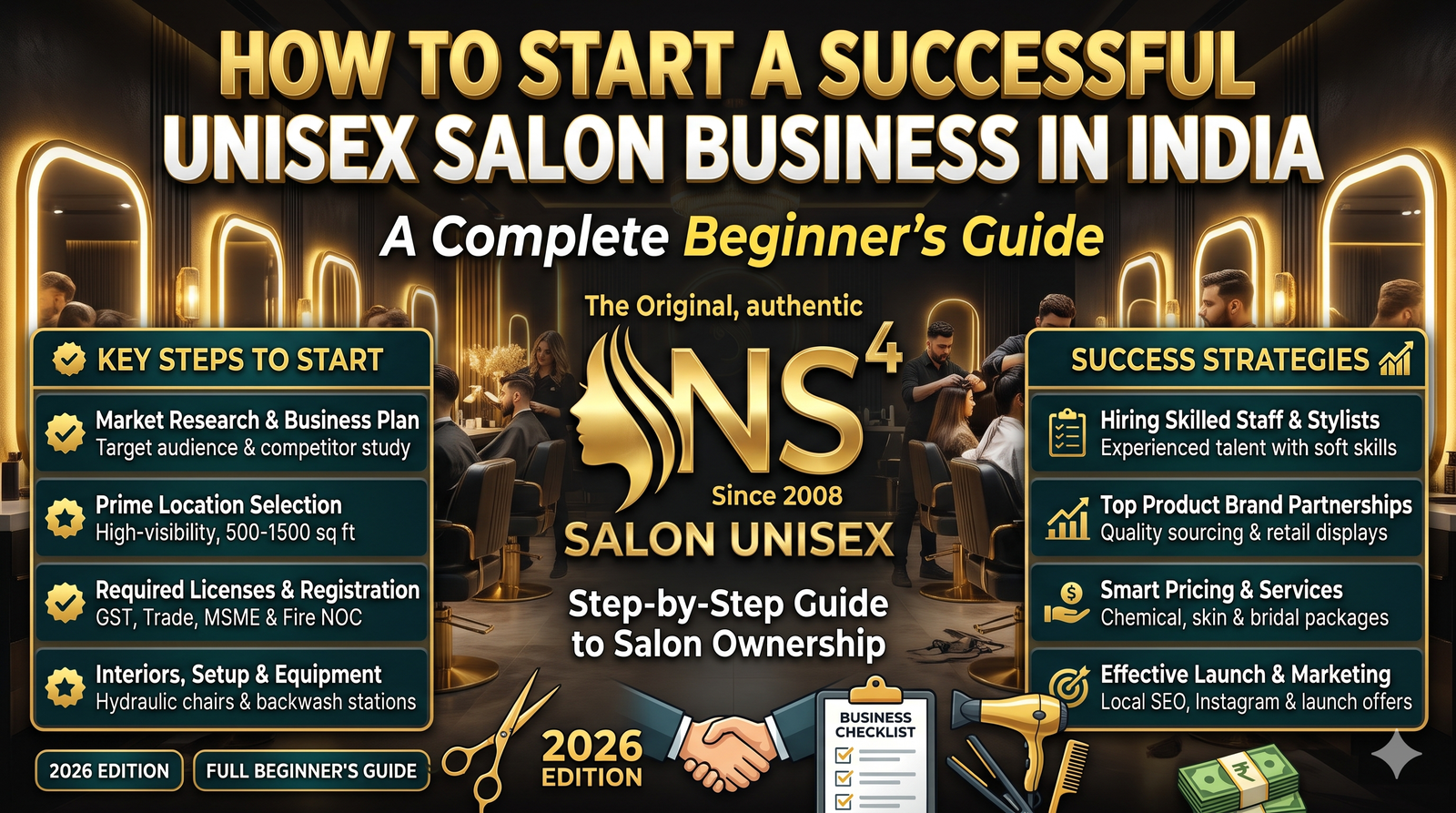
How to Start a Successful Unisex Salon Business in India: A Complete Beginner’s Guide
Starting a unisex salon business in India can be a profitable opportunity for aspiring entrepreneurs who are passionate about beauty, grooming, fashion and customer service. With increasing awareness of personal grooming, professional hair care, skincare, bridal makeup and wellness services, the salon industry offers opportunities in both metropolitan cities and smaller towns.
However, opening a successful salon requires more than investing in interiors and hiring hairstylists. You need a proper business plan, the right location, trained professionals, quality products, effective marketing and a strong customer retention strategy.
Whether you want to open a small neighbourhood salon, a premium unisex salon or invest in an established salon franchise, this beginner’s guide explains everything you need to know.
1. Understand the Unisex Salon Business Model
A unisex salon provides professional beauty and grooming services to both men and women under one roof. Unlike traditional gender-specific salons, unisex salons offer a wider range of services and attract customers from different age groups.
Some popular services include:
- Haircuts and hairstyling for men and women.
- Hair colouring, highlights and global hair colour.
- Keratin, smoothening and hair spa treatments.
- Facial, cleanup and skincare treatments.
- Waxing, threading and bleaching.
- Manicure and pedicure.
- Nail extensions and nail art.
- Bridal and party makeup.
- Grooming and specialised beauty services.
Why choose a unisex salon business?
- Wider target audience.
- Multiple revenue-generating services.
- Opportunities for repeat customers.
- Scope for memberships and packages.
- Opportunities to expand through multiple outlets or franchising.
A well-managed unisex salon can generate revenue from several services instead of depending on a single category.
2. Decide Your Salon Investment Budget
Investment is one of the most important factors when starting a salon business. Your budget will depend on the salon’s size, location, interior design, equipment, services and number of employees.
Here is an illustrative investment estimate for starting a salon in India.
| Expense | Estimated investment |
|---|---|
| Shop security deposit and advance rent | ₹1–3 lakh |
| Interior design and renovation | ₹3–7 lakh |
| Salon furniture and equipment | ₹2–4 lakh |
| Initial salon products and inventory | ₹50,000–1.5 lakh |
| Licences and registrations | ₹10,000–50,000 |
| Branding, signage and launch marketing | ₹30,000–75,000 |
| Working capital | ₹2–4 lakh |
| Estimated total | ₹9–20 lakh |
Illustrative planning estimates, not fixed market prices. Actual costs depend on the city, property, salon size and service range.
For a premium salon in a prime commercial location, the investment can be considerably higher. The Saral+2
Beginner’s tip: Do not spend your entire budget on interiors. Keep sufficient working capital to manage rent, salaries, electricity, products and marketing during the initial months.
3. Choose the Right Salon Location
Location plays a major role in determining your salon’s success. Even an excellent salon can struggle if customers cannot easily find or access it.
Consider these factors before finalising your property:
- Market potential: Choose an area with sufficient residential and commercial population.
- Visibility: Prefer main roads, shopping complexes and busy market areas.
- Accessibility: Ensure customers can reach your salon conveniently.
- Parking: Parking availability can improve the customer experience.
- Competition: Study nearby salons, their pricing, services and customer reviews.
- Rental cost: Choose a property whose rent your expected revenue can support.
Ideal salon size:
- Small salon: 300–500 sq. ft.
- Medium unisex salon: 500–1,000 sq. ft.
- Premium salon: 1,000–1,500+ sq. ft.
These are planning guidelines, not mandatory space requirements.
Before signing a rental agreement, check the property’s commercial-use permissions, electricity load, water supply, drainage and lease conditions.
4. Prepare a Professional Salon Business Plan
A salon business plan helps you understand how much money you need, what services you will provide and how you will generate revenue.
Your business plan should include:
- Business name and brand identity.
- Target audience and customer demographics.
- Salon location and area.
- Initial investment and funding arrangements.
- Services and pricing.
- Staff requirements.
- Monthly operating expenses.
- Marketing strategy.
- Revenue targets and break-even analysis.
- Future expansion plans.
For example, if you plan to open a medium-sized unisex salon, you may start with four to six hairstyling stations, two hair wash stations, a dedicated facial room and a manicure-pedicure section.
Start with services that have regular local demand. Introduce additional premium services as your customer base grows.
5. Complete Salon Registration and Legal Requirements
Before opening your salon, ensure that your business follows applicable government regulations.
Here are the common registrations and permissions to check in India:
| Registration or licence | Purpose |
|---|---|
| Business registration | Establish your proprietorship, partnership, LLP or company |
| Shop and Establishment Registration | Compliance with applicable state labour and establishment laws |
| Municipal Trade Licence | Permission from the relevant local authority, where required |
| GST Registration | Tax compliance when registration becomes applicable |
| Udyam Registration | Optional MSME registration |
| Fire Safety Approval | Required where applicable under local and building regulations |
| Professional Tax Registration | Applicable in certain states |
| Employee Compliance | Applicable EPF, ESI and other labour requirements |
Important GST information: Salon services are subject to the applicable GST rate. Current 2026 guidance identifies a 5% rate without input tax credit for salon services. GST registration generally becomes mandatory when aggregate annual turnover crosses the applicable threshold, commonly ₹20 lakh for service providers, subject to exceptions.
Udyam registration is free through the official government portal. da Salon Blogs+3
Official resource: Udyam Registration Portal.
Requirements vary by state, city and premises. Consult a Chartered Accountant and your local municipal authority before starting operations.
6. Design Your Salon Interior and Purchase Equipment
Your salon interior should create a professional, comfortable and hygienic environment.
A good salon layout should include:
- Reception and waiting area.
- Haircut and hairstyling stations.
- Hair wash section.
- Hair colour and treatment area.
- Separate beauty and facial room.
- Manicure and pedicure section.
- Product display shelves.
- Staff and storage area.
Elevate Your Style at the Closest Unisex Salon in Jayanagar
Shampoo Backwash Units | Shop Salon City – SalonCity
K-Glow | Korean Express Facial, Mayur Vihar Phase 1, New Delhi | Book on LUZO
12
Essential salon equipment checklist:
| Equipment | Purpose |
|---|---|
| Hydraulic styling chairs | Haircutting and styling |
| Styling mirrors and stations | Professional hair services |
| Shampoo wash stations | Hair wash and treatments |
| Hair dryers and straighteners | Hair styling |
| Hair steamers | Hair treatments |
| Facial beds | Skincare services |
| Manicure-pedicure equipment | Nail and foot care |
| Sterilisation and disinfection supplies | Hygiene and safety |
| Trolleys and storage units | Organised operations |
| Billing computer and POS system | Sales and customer management |
Purchase professional-quality equipment that is durable, safe and suitable for your services.
7. Hire Experienced and Trained Salon Professionals
Your employees are one of the biggest factors behind customer satisfaction and business growth.
A medium-sized unisex salon may initially require:
| Position | Suggested staff |
|---|---|
| Salon Manager | 1 |
| Senior Hair Stylist | 1 |
| Junior Hair Stylist | 1–2 |
| Beautician | 1–2 |
| Receptionist | 1 |
| Housekeeping | 1 |
You can adjust the team according to your salon’s size and expected customer demand.
What should you check before hiring?
- Professional qualifications and practical experience.
- Haircutting and colouring skills.
- Knowledge of skin and hair treatments.
- Communication and customer-handling skills.
- Hygiene and safety practices.
- Ability to recommend suitable services and products.
Conduct practical skill tests before hiring senior professionals.
Also, invest in regular training. New hairstyles, hair colouring techniques, skincare treatments and customer expectations continue to evolve.
8. Create an Attractive Salon Service Menu and Pricing Strategy
Your service menu should be easy to understand, competitively priced and profitable.
Here is an illustrative service pricing structure:
| Salon service | Example starting price |
|---|---|
| Men’s Haircut | ₹150 |
| Women’s Haircut | ₹300 |
| Hair Wash and Blow Dry | ₹250 |
| Hair Spa | ₹799 |
| Global Hair Colour | ₹1,999 |
| Keratin Treatment | ₹2,999 |
| Hair Smoothening | ₹3,999 |
| Basic Facial | ₹799 |
| Cleanup | ₹399 |
| Waxing | ₹199 |
| Manicure | ₹399 |
| Pedicure | ₹499 |
| Party Makeup | ₹1,499 |
| Bridal Makeup | ₹5,999 |
Illustrative prices only. Adjust according to your city, customer segment, product consumption, service duration and operating costs.
How to decide the right price?
Consider these factors:
- Product consumption per service.
- Employee commission or service cost.
- Electricity and operating expenses.
- Competitor pricing.
- Customer purchasing capacity.
- Desired profit margin.
Avoid competing only on low prices. Focus on service quality, professional consultation and customer experience.
9. Select Quality Professional Salon Products
Professional products directly influence treatment quality and customer satisfaction.
Your initial product inventory may include:
- Professional shampoos and conditioners.
- Hair masks and hair spa products.
- Hair colour and developers.
- Keratin and smoothening products.
- Hair serums and styling products.
- Facial and skincare products.
- Waxing products.
- Manicure and pedicure products.
- Disinfectants and hygiene supplies.
Work with reliable suppliers and authorised distributors. Check product authenticity, expiry dates and usage instructions.
You can also create retail revenue by recommending suitable home-care products to customers after their salon services.
For example, a customer receiving a hair spa can be recommended an appropriate shampoo and conditioner for maintaining results at home.
10. Promote Your Salon Through Digital Marketing
Opening a salon is only the first step. Attracting customers and building a loyal customer base is what makes the business successful.
Digital marketing can help you reach potential customers in your local area.
美容師のSNSマーケティング完全ガイド|Instagram・TikTokで集客を増やす実践術 | コラム | コスタヘアー
10
Effective marketing strategies:
A. Instagram Marketing
- Post hair transformation reels.
- Share haircut and hair colour videos.
- Upload customer testimonials.
- Showcase bridal makeup and nail art.
- Share service offers and seasonal promotions.
B. Google Business Profile
Create and optimise your Google Business Profile.
Add:
- Salon address and contact details.
- Business hours.
- Service list and photographs.
- Customer reviews.
- Booking and website links.
This helps potential customers discover your salon through Google Search and Maps.
C. WhatsApp Marketing
Use WhatsApp Business to:
- Share service menus.
- Send promotional offers.
- Confirm appointments.
- Send birthday discounts.
- Inform customers about new services.
Always obtain appropriate customer consent before sending promotional messages.
D. Local Marketing
- Distribute introductory offer cards.
- Partner with gyms and boutiques.
- Run local influencer campaigns.
- Offer referral discounts.
- Organise a grand opening event.
E. Customer Referral Program
Encourage existing customers to refer friends and family.
For example:
“Refer a Friend and Get ₹200 OFF on Your Next Salon Visit.”
A well-planned referral programme can help generate repeat visits and word-of-mouth promotion.
11. Use Salon Management Software
Managing appointments, billing, inventory and employee performance manually can become difficult as your salon grows.
A salon management system can help you manage:
- Customer databases.
- Appointment bookings.
- Billing and payment records.
- Employee attendance.
- Service-wise sales.
- Product inventory.
- Membership plans.
- Customer visit history.
- Daily and monthly reports.
Track your salon’s performance regularly to understand which services generate the highest revenue.
12. Focus on Customer Retention and Membership Programs
Getting a new customer is important, but retaining existing customers is equally important.
Introduce loyalty programmes to encourage repeat visits.
Some ideas include:
- Monthly haircut memberships.
- Hair spa packages.
- Facial and skincare packages.
- Prepaid service vouchers.
- Birthday discounts.
- Referral rewards.
- Annual grooming memberships.
For example, you can introduce a monthly grooming membership offering selected haircuts and grooming benefits at an attractive price.
Make sure your membership terms clearly explain validity, included services, usage limits and refund conditions.
13. Understand Salon Profitability and Break-Even
Before opening your salon, calculate your expected monthly expenses and revenue.
Here is an illustrative monthly financial model:
| Expense | Monthly cost |
|---|---|
| Rent | ₹50,000 |
| Staff salaries | ₹1,50,000 |
| Electricity | ₹15,000 |
| Product consumption | ₹40,000 |
| Marketing | ₹15,000 |
| Miscellaneous expenses | ₹15,000 |
| Total expenses | ₹2,85,000 |
Suppose your salon generates ₹4,50,000 in monthly service and product revenue.
Illustrative monthly business calculation
Monthly revenue
₹4.50 L
Monthly expenses
₹2.85 L
Operating surplus
₹1.65 L
Surplus margin
36.7%
Before applicable taxes, depreciation, interest, owner remuneration and any unlisted expenses. This is not a guaranteed profit forecast.
How to calculate break-even sales?
Break-even is the point where your total revenue covers your fixed and variable expenses.
For example, if your fixed monthly costs are ₹2 lakh and your contribution margin is 60%, your break-even monthly revenue is:
\[ ₹2,00,000 \div 0.60 = ₹3,33,333 \]
This means your salon needs approximately ₹3.33 lakh in monthly sales to cover those assumed costs.
Do not confuse total sales with net profit. Proper financial planning is essential for long-term success.
14. Common Mistakes to Avoid When Starting a Salon
Many first-time salon owners make avoidable mistakes that affect their business growth.
Here are some important mistakes to avoid:
- Choosing an expensive location without studying demand.
- Spending too much on interiors.
- Hiring untrained or inexperienced professionals.
- Offering too many services without proper expertise.
- Ignoring customer feedback.
- Not maintaining proper financial records.
- Depending only on discounts to attract customers.
- Ignoring social media and local marketing.
- Failing to maintain hygiene standards.
- Not keeping sufficient working capital.
A successful salon is built through consistent service quality, customer trust and disciplined management.
15. Should You Start an Independent Salon or Choose a Salon Franchise?
This is one of the most important decisions for a beginner.
Both business models have advantages and challenges.
| Independent salon | Salon franchise |
|---|---|
| Complete control over branding | Established brand identity |
| Freedom to create your own services | Access to a defined service model |
| You develop marketing independently | May receive marketing support |
| You create your own operating systems | May receive standard operating procedures |
| Build your own customer base | Potential benefit from existing brand recognition |
| Full responsibility for business planning | Support depends on the franchise agreement |
When should you choose an independent salon?
An independent salon may be suitable if:
- You have professional salon experience.
- You understand salon operations.
- You already have a customer base.
- You can develop your own brand.
- You have the resources to manage everything independently.
When should you consider a salon franchise?
A franchise may be suitable if:
- You are a first-time entrepreneur.
- You want to work with an established brand.
- You need guidance on salon setup.
- You want structured training and operating systems.
- You prefer a defined business model.
Before investing, compare franchise fees, royalty, setup costs, training, marketing support, territory rights and the actual responsibilities mentioned in the agreement.
16. Explore NS4 Salon Franchise Opportunities
If you want to enter the salon industry but need professional guidance, exploring an established salon franchise can be a practical option.
NS4 Salon is a salon brand established in 2008, offering hair, beauty and grooming services.
The NS4 Salon franchise opportunity is designed for entrepreneurs who want to establish a professional salon business with brand support and a structured operating model.
Potential franchise support areas include:
- Salon setup and interior guidance.
- Staff training and development.
- Service menu and pricing guidance.
- Professional salon products and equipment guidance.
- Marketing and promotional support.
- Operational systems and business guidance.
If you are planning to start a salon business, explore the franchise model and understand the investment, brand fee, royalty structure and support before making a decision.
Interested in starting your own salon?
Visit NS4 Salon Official Website to explore the brand and its business opportunities.
17. Final Checklist Before Opening Your Unisex Salon
Use this checklist to prepare for your salon launch.
- Finalise your salon business model.
- Prepare your investment budget.
- Select the right commercial location.
- Complete business registration.
- Obtain applicable licences and permissions.
- Finalise salon interiors and equipment.
- Purchase professional salon products.
- Hire experienced hairstylists and beauticians.
- Create your service menu and pricing.
- Set up billing and appointment software.
- Create social media accounts.
- Set up your Google Business Profile.
- Plan your grand opening offer.
- Prepare a monthly sales and expense report.
Conclusion
Starting a successful unisex salon business in India requires proper planning, financial discipline, skilled professionals and a customer-focused approach.
From selecting the right location and managing investment to hiring trained staff and implementing digital marketing, every step contributes to your salon’s long-term growth.
If you are a beginner, start with a clear business plan, understand your local market and focus on delivering excellent customer experiences.
Remember, a successful salon is not built by interiors alone. It is built through customer trust, professional services, consistent quality and effective business management.
Whether you choose an independent salon or a franchise opportunity like NS4 Salon, make informed decisions and build your salon business with a long-term vision.
Frequently Asked Questions (FAQs)
1. How much investment is required to start a unisex salon in India?
A small to medium-sized unisex salon may require approximately ₹9–20 lakh, depending on location, interiors, equipment, staff and working capital. Premium salons may require a higher investment.
2. Is a unisex salon business profitable in India?
Yes, a unisex salon can be profitable when it has consistent customer demand, skilled professionals, effective pricing, controlled operating costs and repeat customers. Profitability depends on business management and location.
3. How much space is required to open a unisex salon?
A small salon may operate in 300–500 sq. ft., while a medium salon may require 500–1,000 sq. ft. Premium salons may need 1,000 sq. ft. or more.
4. What licences are required to open a salon in India?
Common requirements include Shop and Establishment registration, municipal trade licence where applicable, GST registration when required and relevant fire safety approvals. Requirements vary by location.
5. How many employees are required to run a unisex salon?
A small salon may start with three to five employees, while a medium-sized salon may need six to ten employees, depending on its services and operating hours.
6. Which salon services generate the most revenue?
Hair colouring, keratin treatments, smoothening, hair spa, skincare, bridal makeup and premium grooming services can generate significant revenue, depending on local customer demand and pricing.
7. Can I start a salon business without having experience?
Yes. You can own and operate a salon without being a hairstylist, but you should hire experienced professionals and understand salon management, customer service, finance and marketing.
8. Is a salon franchise better than starting an independent salon?
A franchise may offer brand recognition, training and operational support. An independent salon offers more freedom but requires you to develop your own brand, systems and marketing strategy.
9. How can I attract more customers to my new salon?
Use Instagram reels, Google Business Profile, customer referrals, introductory offers, local advertising and WhatsApp marketing to attract customers.
10. How long does it take to establish a successful salon?
It varies according to location, investment, competition and management. Building a stable customer base generally requires consistent marketing and service quality over several months.